Wind Instrument resources
Wind Instrument resources
Woodwinds, Brass, & Percussion
Students with Percussion-specific questions should reach out directly to Dan Johnson, our Director of Percussion: vierapercussion@gmail.com
Percussion stuff:
- https://vicfirth.zildjian.com/education.html
- The Complete Percussionist: https://www.youtube.com/watch?v=DPoEzXLmVjg&t=1211s https://www.youtube.com/watch?v=DPoEzXLmVjg&t=1211s
Online Metronome: https://www.metronomeonline.com/
Online Tuner: https://theonlinemetronome.com/instrument-tuner
Music Dictionary: https://dictionary.onmusic.org/
Band Instrument Specific Video Lessons (Playlist: Kahn Academy/US Marine Band):
https://www.youtube.com/playlist?list=PLA7no0L9zTk7D-MSOHCIWP1_vg-ULl85N
Great videos made by the US Army Field Band can be found on Youtube as well - search "Army Field Band <INSTRUMENT>"
Woodwind & Brass Instrument Specific Resources
https://drive.google.com/drive/folders/1ypNbEGHs3AWIJjVbXSTvz-bbhEJi072t?usp=share_link
Each folder contains things like:
- Instrument Guides
- Instrument Care Guides
- Fingering/Trill Charts
- Scale sheets
Instrument Cleaning Instructions: https://drive.google.com/file/d/1a9PsYId5-KubjLUhVyJs4XRpp3ItFEIr/view?usp=share_link
Common Instrument Repair Problems: https://drive.google.com/file/d/14BPyDDuOGzo6Jwq00D4tE22i4QDDz3OJ/view?usp=share_link
Woodwind Specific Maintenance: https://drive.google.com/file/d/150Aj6YJpAo0a1Ix29Pzd5ss1rfU6LRMX/view?usp=share_link
Brass Specific Maintenance: https://drive.google.com/file/d/1OwVUDB0ewMpv97U3jkJuILYDAI5BBdc5/view?usp=share_link
STEP-UP MUSICAL INSTRUMENTS
Your student's starter instrument is designed with the new musician in mind, as it is crafted to be durable in the hands of a beginner. Even if your child only wants to play in the school band, they will likely outgrow that instrument. As your student progresses on their musical journey, they will struggle to master more difficult techniques, and could become dissatisfied. A day will come when they will benefit from an instrument that supports their growing ability. The difference between a beginner instrument and a step up instrument are not usually obvious visually. Here's what you will notice with a step up instrument.
Craftsmanship and quality materials used in construction. Improved instrument response and richness of sound leads to improved musicianship and musical enjoyment for your student. The skilled craftsmanship and higher quality material of a 'Step Up' instrument, combined with the skill level of your musician, gives your student the best chance at success.
WOODWIND ACCESSORIES
Reeds have a significant impact on how woodwind instruments sound. Picking the right reed can drastically improve sound, will respond more consistently and last longer than other reeds. Your local music store sells these brands and usually has them in stock!
Recommended Reed Brands:
Mitchell Lurie: https://www.daddario.com/products/woodwinds
"Blue Box" Vandoren: https://www.wwbw.com/Vandoren-Alto-Saxophone-Reeds-462581.wwbw
Other Vandoren series (Clarinet): https://vandoren.fr/en/clarinet-reeds/
Other Vandoren series (Saxophone): https://vandoren.fr/en/saxophone-reeds/
Oboe & Bassoon: https://www.forrestsmusic.com/
Strength of Reed will vary from individual to individual; generally:
9th Grade - 3
10th-12th Grade:
Similarly, the ligature (the part that holds the reed on the mouthpiece) can significantly affect sound.
Recommended Ligatures:
Rovner: https://www.wwbw.com/Rovner-Dark-Bb-Clarinet-Ligature-and-Cap-540295.wwbw
BG: https://www.wwbw.com/BG-L6-Standard-Bb-Clarinet-Ligature-465083.wwbw
Reed Care
Reeds are greatly affected by temperature and humidity. This is why a reed may play very well one day, and then hardly at all. Storing reeds in a consistent humidity level will ensure more consistent response and will also extend the life of the reed.
Reed Cases: https://vandoren.fr/en/accessories/
When played, instruments commonly generate some moisture. This is a combination of saliva (only a little!) and mostly condensation due to the air flowing through the instrument. Instrument Swabs can help draw the moisture out of the instrument at the end of a practice or performance increasing the life of the pads.
FLUTE
Consider an instrument with one or more reeds. If not, proceed directly to brass.
CLARINET
Trumpet.
See note about reeds and ligatures above.
SAXOPHONE
Clarinet.
See note about about reeds and ligatures.
OBOE
Recommended Oboes:
Idk, what you have is probably fine.
Maybe consider kazoo?
BASSOON
Recommended Accessory:
Strategically Placed Sheet of Paper (Range Extension)
BRASS MOUTHPIECES
Similar to woodwinds, mouthpieces can have a significant impact on tone and response. Below are some general guidelines regarding mouthpiece shape.
Mouthpiece Rim
Wide: Increases endurance.
Narrow: Improves flexibility
Round: Improves comfort.
Sharp: Increases precision of attack
Mouthpiece Cup
Large: Increases volume, control.
Small: Relieves fatigue, weakness.
Deep: Darkens tone, especially in low register.
Shallow: Brightens tone, improves response, especially high register.
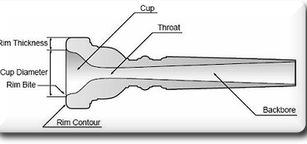
Mouthpiece Throat
Large: Increases blowing freedom, volume, tone; sharpens high register (largest sizes also sharpen low register).
Small: Increases resistance, endurance, brilliance; flattens high register.
TRUMPET
Beginner trumpets have small bores (inside size of the tubing), making them easier to play but sacrificing some potential tone. They're typically finished with clear lacquer, allowing the the brass to show through, and include the most basic features. They are designed for early use.
Intermediate trumpets are typically slightly larger in bore, allowing bigger, fuller sound production. They are usually finished in silver for a slightly darker tone and more attractive appearance. Valves and slides are typically fitted to closer tolerances, minimizing leakage of air that causes a player to work harder. Mouthpieces tend to be slightly larger and more open, and features like slide rings and triggers allow intonation adjustments.
Recommended Step Up Trumpets:
Bach TR200 (better) Stradivarius 180 (best)
Conn Vintage 1
Yamaha 4335 (better), 6335, 8335 or 8345 Xeno (either best)
Getzen
Recommended Mouthpieces:
Beginner Bach 7C
Intermediate Bach 5C
High School or above Bach 3C
HORN
Quality step-up French Horns will be double horns, sometimes silver plated.
Recommended Step Up French Horns:
Holton Farkus Model
Yamaha 567 (better), 667 or 668 (both best)
Recommended Mouthpieces:
Holton Farkus (Medium Deep Cup)
Shilke 31B
TROMBONE (TENOR & BASS)
Quality step-up trombones should have an "F" attachment and will have a wider bore (the inner width of the slide). Beginner instruments have a narrow bore to facilitate ease of play, however, this can create a thin sound that can get in the way of a more advanced performer. An "F" attachment directs air th 1rough additional tubing allowing for performers alternative ways of reaching difficult slide positions.
Recommended Step Up Tenor Trombones:
Bach TB200 Series F Attachment Trombone (Good)
Yamaha YSL-448G Intermediate Trombone (Good)
Yamaha YSL-882O Xeno Series F Attachment (Better)
Bach Stradivarius 42 (Better)
Conn 88H (Better)
Bach Stradivarius 50 (Bass Trombone)
Recommended Mouthpieces
6 1/2 AL
5G
Bach 1 1/2 G (Bass Trombone)
Bach 1G (Bass Trombone)
EUPHONIUM/BARITONE
After playing baritone or euphonium for a few years, beginning players often start to look for ways to enhance the sound of their instrument. While a new mouthpiece can improve the sound initially, it may eventually be appropriate to consider a new instrument altogether. If a student is taking private lessons or playing more advanced music, it may be time to upgrade their student-level baritone or euphonium to a performance-quality, or “step-up,” euphonium. Designed for sound projection and better response, most step-up euphoniums feature a yellow brass, upright bell and larger bore. The addition of a fourth valve extends the range of the instrument and provides the player with alternate fingerings.
Compensating Lower Brass
The term "compensating" is one that is often referred to but not always fully understood. It is normally used with reference to lower brass instruments (eg. Euphoniums & Tubas) which are either 'compensating' or 'non-compensating' models. There is a common misconception that if an instrument has a 4th valve* it is compensating, but that is not necessarily the case.
Recommended Step Up Euphoniums
Yamaha YEP-321
Yamaha YEP 642
Besson models
Miraphone models
Willson models
Recommended Mouthpieces
Bach 6 ½ AL
Bach 5G
Bach 3G
Yamaha 51D
TUBA
When looking at Step Up brass it is important to note the different alloys used in brass instrument construction: yellow brass, gold brass, red brass and nickel silver. Yellow brass is the most common (70% copper, 30% zinc) and is generally used on student models. Gold brass (85% copper, 15% zinc) will produce a broad, rich tone, but can be pricey. Red brass generally contributes to softer mellow tones. Nickel silver (70% copper, 20% zinc, 10% nickel) produces a bright sound and because of the higher percentage of nickel and zinc will make for a more durable horn.
When shopping for a tuba, it is important to understand that this will not be a cheap endeavor. Pending the store you purchase it from you may need to make payments. As far as details go, tubas come in different sizes depending on the make and model. A ¾ size tuba, while being cheaper was made and designed for elementary and middle school band sized students. There are also tubas tuned to Bb, C, Eb and F.
For the purposes of band, we recommend a four rotor Bb tuba. Tubas come with either piston valves or rotors. Generally it is a matter of preference to the player. Each has benefits and issues. I personally recommend rotors, based on fingering agility and easier to maintain.
If you are buying your child a tuba, make sure that they are serious about their studies as this is a large upfront investment. Along with that, a good quality tuba will last a lifetime if well maintained!
Recommended Step Up Tubas:
St. Petersburg (Tuba Exchange)
Miraphone 282 Series ¾ Size BBb Tuba
Miraphone S186 Standard Series BBb Tuba
Meinl Weston 18 Handy Series ¾ BBb Tuba
Professional Level: Meinl Weston, Miraphone, Kanstul
Recommended Mouthpieces:
Conn Helleberg Standard, Perantucci PT-50
Bach 22
Bach 18
STRING INSTRUMENTS & ACCESSORIES
A student’s instrument, bow, or strings can dramatically impact his or her sound and enjoyment in playing.
Instrument Step Up: If your instrument is not currently matching your playing ability, we encourage you to consider purchasing or “stepping up” to a better instrument. Students who rent from Atlantic Strings are able to step up to a higher quality instrument at a minimal price per month.
Strings: Strings can be purchased at Fishburn, Lisle, or online at sharmusic.com or even on Amazon! I recommend that violin/viola students change their strings one to two times per year and cellos/bass studnets change their strings every year to 18 months. Violas make sure you know what size you’re getting and Violins whether you need a loop or ball end string E string.
Violin Recommended Strings
Kaplan Vivo (medium gauge)
Larsen Virtuoso (medium gauge)
Thomastik Dominant G,D, & A strings with a Pirastro Gold Wondertone E string (medium gauge)
D’Addario Pro Arte or Overture Ultra strings (medium gauge) are acceptable as well for Concert or Phil students only.
Viola Recommended Strings
Kaplan Amo – (long scale, medium gauge)
Thomastik Dominant C, G, & D strings with a Larsen A string (medium gauge).
Thomastik Alphayue
D’Addario Zyzex – (long scale, medium gauge)
Jargar (medium gauge)
Cello Recommended Strings
D’Addario Helicore
Larsen A & D strings with Thomastik Spirocore or Dominant G and C strings.
Bass Recommended Strings
D’Addario Helicore
STRING ACCESSORIES
https://thevault.musicarts.com/upgrade-your-sound-essential-orchestral-string-accessories/